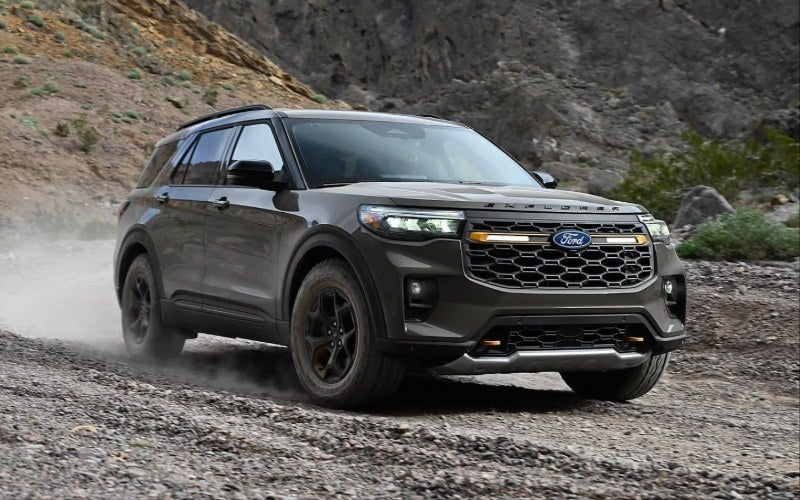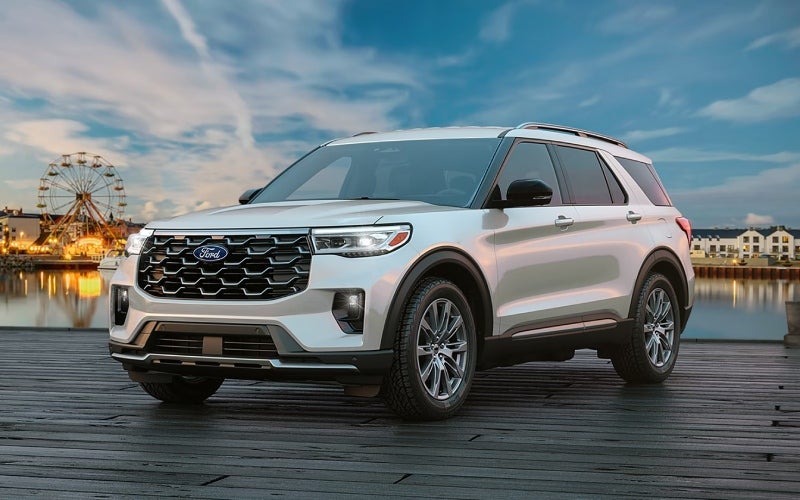
Alpine Ford - Does the 2027 Ford Explorer Have Enough Space for Castle Rock, CO Family Driving? Family SUV shoppers around Castle Rock, CO often need more than a simple answer about passenger capacity. The better question is how well an SUV uses its space during real routines: school drop-offs, weekend activities, work commutes, grocery runs, airport drives, and trips along I-25 toward Denver or Colorado Springs, CO. The 2027 Ford Explorer® is built with that kind of daily flexibility in mind, offering three-row seating, useful cargo room, and multiple seating configurations that help shoppers choose the right setup for each household. The Explorer® is not just a vehicle with extra seats added into the back. Ford designed it as a midsize SUV with a practical cabin layout, comfortable materials, smart technology, and enough cargo versatility to adapt throughout the week. The standard second-row captain’s chairs make the cabin feel open and easy to navigate, while the available second-row bench seat on all models except Tremor® gives families the option for seven-passenger seating. That choice matters because not every household uses a three-row SUV the same way. How Many People Can the 2027 Ford Explorer® Seat? The 2027 Ford Explorer® can seat six or seven people, depending on the model and seating configuration selected. Second-row captain’s chairs are standard on all models. This setup creates a six-passenger cabin with a clear pass-through to the third row, which can make life easier when passengers frequently move between rows. For many families, captain’s chairs are a major advantage because each second-row passenger gets a defined seat with added personal space. For shoppers who want maximum passenger capacity, a second-row bench seat is available on Active, ST-Line, Platinum™, and ST models. The bench seat raises capacity to seven passengers. Tremor® is the exception, as it keeps the standard captain’s chair layout. That makes sense for a model focused on off-road-minded capability and distinctive hardware, but families needing seven seats will want to compare other Explorer® models closely. Here is a simple way to think about the seating choice: Captain’s chairs: Best for easy third-row access, added second-row comfort, and households with frequent rear-seat passengers. Second-row bench: Best for maximizing passenger count and carrying up to seven people in one vehicle. Tremor® layout: Best for shoppers who want standard six-passenger seating with added off-road-focused capability. That flexibility is one reason the Explorer® works well for families who want a vehicle that can evolve with changing schedules. A household with younger children may prefer easier third-row access. A household that regularly transports friends, relatives, or teammates may prefer seven-passenger capacity. How Much Cargo Space Does the Explorer® Offer? Cargo space is another key part of the family-SUV decision. The 2027 Ford Explorer® offers 16.3 cu ft of cargo capacity behind the third row with all seats in place. That space is useful for daily items such as backpacks, grocery bags, small sports bags, and work gear. When more room is needed, folding the rear seats opens up a much larger cargo area. Active and ST-Line models offer up to 85.8 cu ft of maximum cargo capacity. Tremor®, Platinum™, and ST models offer up to 85.3 cu ft. The difference is small, but it is worth noting for detail-focused shoppers comparing trims. More importantly, the Explorer® gives drivers the ability to adapt the cabin quickly. Available PowerFold® third-row seats on Tremor® and standard PowerFold® third-row seats on ST and Platinum™ make it easier to switch between passenger and cargo needs. That kind of space is especially valuable around Castle Rock, CO, where daily life can include commuting, errands, school activities, recreation, and family travel. A vehicle needs to manage more than passengers. It needs to carry folding chairs, luggage, coolers, gear bags, home improvement supplies, pet items, and everything else that comes with a full week. Comfort Matters in Every Row Space is more useful when passengers feel comfortable using it. The Explorer® offers a thoughtful interior with available seating materials that range from comfy cloth to Miko® Suede, durable ActiveX®, and soft leather. That range gives shoppers the freedom to prioritize easy-care durability, premium feel, or a sportier look depending on the model selected. Front-row comfort can be especially impressive on upper trims and available packages. Platinum™ offers heated, ventilated, massaging front-row seats with leather inserts. Tremor® models with the 3.0-liter EcoBoost® engine can add the Sun & Sound Package, which includes massaging front seats, a power moonroof, and an upgraded B&O® Sound System. Those features matter on longer drives because the driver and front passenger often spend the most time in the vehicle. The Explorer® also provides strong interior dimensions for a midsize three-row SUV. OEM information lists front headroom at 40.7 inches, middle headroom at 40.5 inches, and rear headroom at 38.9 inches. Front legroom measures up to 43 inches on Active and ST-Line models, with second-row and third-row legroom designed to support practical passenger use. Third rows in midsize SUVs are often best suited for children, teens, or shorter adult trips, but the Explorer® uses its footprint well. Technology That Supports Family Driving A spacious cabin becomes even better when the technology is helpful rather than distracting. The 2027 Ford Explorer® includes the Ford Digital Experience, which brings familiar digital functionality and apps into the vehicle in a way designed to enhance the drive. For families, that can mean easier navigation, better entertainment access, and a more modern front-cabin experience. Driver-assist technology is also important. Ford Co-Pilot360® Technology is focused on helping drivers feel more confident behind the wheel. Active models include Ford Co-Pilot360® driver-assist features, including Adaptive Cruise Control. Available BlueCruise can add hands-free highway driving assistance on compatible highways, helping control steering, braking, and acceleration while the driver keeps eyes on the road ahead. For frequent I-25 travel near Castle Rock, that technology can make longer highway stretches feel more manageable. Some shoppers will also appreciate available camera technology. ST-Line includes a 360-degree camera, which can be useful in parking lots, garages, school pickup lanes, and tight urban spaces. A larger SUV feels easier to live with when visibility tools help provide added awareness around the vehicle. Which Explorer® Model Fits a Family Best? The best Explorer® model depends on how the SUV will be used. Active is a strong starting point with the 2.3L EcoBoost® engine, heated front-row seats, Ford Co-Pilot360® driver-assist features, and the Ford Security Package. ST-Line adds distinctive style, unique cloth-trimmed front- and second-row seats with red stitching, the 360-degree camera, and a B&O® Sound System by Bang & Olufsen® with 10 speakers, including a subwoofer. Tremor® makes sense for shoppers who want extra confidence beyond pavement, thanks to a Torsen® limited-slip rear axle, off-road-tuned suspension with increased ride height, and underbody protection with front and rear deflector plates. Platinum™ is the luxury-minded choice, with premium comfort and available 3.0L EcoBoost® V6 power. ST is the performance-focused model, featuring the 3.0L EcoBoost® engine, sport-tuned suspension, performance brakes with red-painted calipers, and BlueCruise equipped. For a family-focused test drive, consider this checklist before choosing a trim: Bring everyday cargo: Test the rear space with strollers, sports bags, backpacks, or luggage if those items are part of your routine. Test third-row access: Ask passengers to climb in and out of the third row using the second-row layout you prefer. Compare six and seven seats: Decide whether captain’s chairs or the available bench seat better fits your household. Use the infotainment system: Try navigation, audio, wireless connectivity, and the Ford Digital Experience during the drive. Evaluate parking confidence: Test visibility, camera views, steering feel, and overall maneuverability in realistic settings. Taking this approach turns the test drive into a practical evaluation rather than a quick loop around the block. A three-row SUV should make life easier, and the best way to confirm that is to use the vehicle the way your family will use it. Frequently Asked Questions: Is the 2027 Ford Explorer® good for families with multiple children? Yes. The Explorer® is a strong family SUV because it offers three-row seating, standard second-row captain’s chairs, available seven-passenger seating on most models, and useful cargo space behind the third row. Families can choose the seating layout that best fits daily passenger needs. Can the Explorer® carry cargo when all seats are in use? Yes. The 2027 Ford Explorer® provides 16.3 cu ft of cargo space behind the third row with all seats in place. That is useful for groceries, backpacks, smaller sports gear, and travel bags. Folding the rear seats expands cargo capacity significantly. Which Explorer® model has the most cargo room? Active and ST-Line models offer the highest listed maximum cargo capacity at 85.8 cu ft. Tremor®, Platinum™, and ST models offer up to 85.3 cu ft. All models provide the same 16.3 cu ft behind the third row when all seats are in place. Does the Explorer® offer technology for highway driving near Castle Rock, CO? Yes. The Explorer® offers available BlueCruise, a hands-free highway driving assistance feature for compatible highways. Ford Co-Pilot360® driver-assist technology is also available across the lineup to help support confidence behind the wheel. The 2027 Ford Explorer® has enough space for many family driving needs because it combines passenger flexibility, practical cargo volume, comfortable materials, and helpful technology. It is not only about fitting people into three rows; it is about making the cabin easier to use during a busy week. From six-passenger comfort to available seven-passenger capacity, the Explorer® gives shoppers meaningful options. For Castle Rock, CO families comparing midsize SUVs, the Explorer® deserves a close look because it blends everyday usability with model-specific personality. Active, ST-Line, Tremor®, Platinum™, and ST each offer a different path, but the core strengths remain the same: three-row versatility, smart storage, available advanced driver assistance, and a cabin designed around real life. Request more 2027 Ford Explorer information
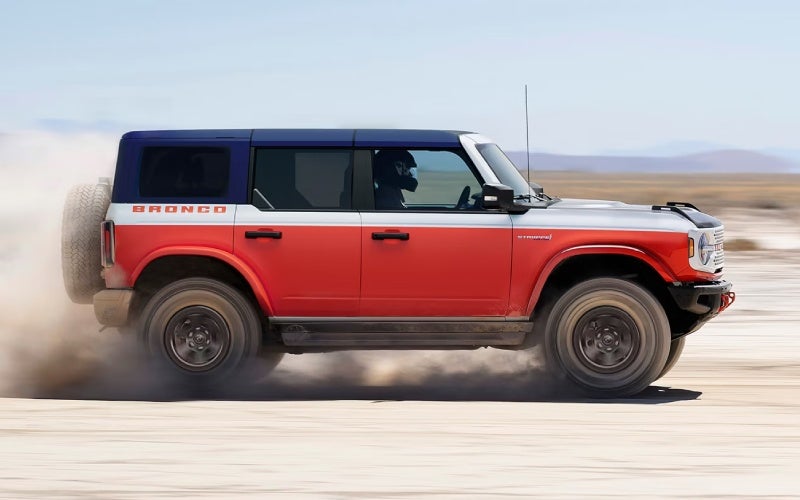
How G.O.A.T. Modes® Help Denver, CO Drivers Get More from the 2026 Ford Bronco®
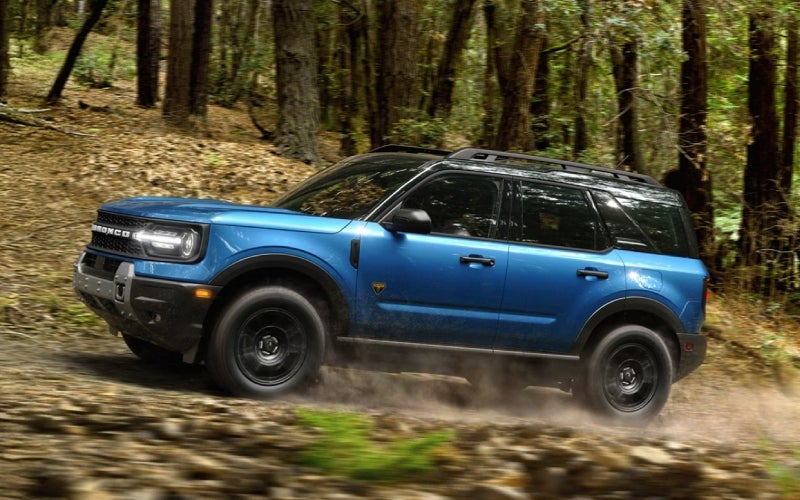
Alpine Ford - How G.O.A.T. Modes® Help Denver, CO Drivers Get More from the 2026 Ford Bronco® The 2026 Ford Bronco® is known for bold design, removable-door freedom, and rugged available hardware, but one of its most useful features is also one of the easiest to appreciate from the driver’s seat: G.O.A.T. Modes®. Short for Goes Over Any Type of Terrain, this Ford drive mode system helps the Bronco® adapt its behavior to different surfaces and driving conditions. For Denver, CO drivers who move between city traffic, foothill roads, gravel access routes, and weekend trailheads, that kind of adaptability can make the Bronco® feel composed, capable, and confidence-inspiring without asking the driver to manually fine-tune every system. What makes G.O.A.T. Modes® especially valuable is how well it fits the Bronco® personality. This is not a crossover with a rugged costume. The Bronco® is engineered with available off-road hardware, available HOSS (High-Performance Off-Road Stability Suspension) Systems, Trail Control, Trail Turn Assist, substantial ground clearance when properly equipped, and a lineup that ranges from approachable daily driving trims to the high-performance Bronco® Raptor®. G.O.A.T. Modes® works as the bridge between those mechanical strengths and the driver’s real-world needs, helping tailor throttle response, traction control behavior, steering feel, transmission mapping, and four-wheel-drive settings depending on configuration. What G.O.A.T. Modes® Actually Do At a basic level, G.O.A.T. Modes® help the Bronco® adjust to the environment beneath the tires. That matters because a paved commute and a rutted trail require different vehicle behavior. On pavement, a smooth and predictable response is usually the priority. On loose dirt, the vehicle may need to manage wheel slip differently. On rocks, low-speed control becomes more important than quick acceleration. Rather than forcing the driver to approach each condition the same way, G.O.A.T. Modes® let the Bronco® shift its character to better match the moment. Depending on trim and equipment, the 2026 Bronco® offers up to seven available G.O.A.T. Modes®. That range supports the wide variety of situations Bronco® owners often encounter. A driver leaving a downtown parking garage has very different needs than a driver easing over uneven terrain west of the metro area, but the same SUV can serve both purposes well. This is one reason the Bronco® continues to appeal to shoppers who want a true adventure vehicle without giving up daily usability. Why Denver, CO Drivers Benefit from Terrain-Focused Tech Denver-area driving is varied in a way that rewards versatility. A typical week can involve highway driving, neighborhood streets, steep grades, unpaved parking areas at recreation sites, and changing road surfaces as elevation increases. G.O.A.T. Modes® support that mix by helping the Bronco® feel less like a one-purpose off-roader and more like a smart, adaptable SUV. You do not need to be an expert trail driver to appreciate the difference. Even drivers who only explore light trails occasionally can benefit from having a vehicle that responds more appropriately to changing terrain. The system also pairs well with the Bronco® model range. A Big Bend® can be a smart entry into Bronco® capability, while Badlands® adds more trail-focused confidence. The available Sasquatch® Package brings an even more aggressive stance and off-road equipment, and the Bronco® Raptor® pushes performance further with a 418 horsepower 3.0L EcoBoost® V6 engine and advanced HOSS System 4.0 with FOX™ Live Valve 3.1 Internal Bypass Semi-Active Dampers. Across the lineup, G.O.A.T. Modes® help make those engineering choices more approachable from behind the wheel. How G.O.A.T. Modes® Work with Other Bronco® Features G.O.A.T. Modes® are most impressive when viewed as part of the larger Bronco® capability system. The 2026 Bronco® can be equipped with features designed to help on narrow paths, rocky sections, steep grades, and low-speed technical areas. Trail Turn Assist can help reduce the turning radius in certain off-road situations, which is useful when the path ahead is tight. Trail Control functions like low-speed cruise control for trail driving, helping manage speed so the driver can focus more attention on steering. The available 360-Degree Camera can also help provide added visibility around the vehicle when obstacles are close. G.O.A.T. Modes®: Help optimize vehicle behavior for different surfaces and driving situations. Trail Control: Helps manage low-speed progress on challenging terrain. Trail Turn Assist: Supports sharper maneuvering in certain off-road conditions. Available HOSS Systems: Bring off-road suspension engineering to Bronco® capability. Available 360-Degree Camera: Helps with visibility around obstacles, parking areas, and tight routes. That combination is important because off-road confidence rarely comes from one feature alone. It comes from how well the powertrain, suspension, traction systems, visibility tools, and driver controls work together. In the Bronco®, the experience feels intentional. Ford designed the SUV for people who actually plan to use its capability, whether that means mild dirt roads or more demanding routes with elevation changes and uneven surfaces. Everyday Driving Still Matters One misconception about the Bronco® is that its trail capability must come at the expense of daily convenience. The 2026 model helps challenge that idea with thoughtful technology and comfort features. Standard wireless Apple CarPlay® and Android Auto™ compatibility make it easy to bring familiar maps, audio, and communication tools into the cabin. Available heated seats and an available heated steering wheel add comfort, while available marine-grade vinyl seating surfaces and washable floors with built-in drains are practical for active lifestyles. The Bronco® feels ready for the outdoors, but it does not ignore the everyday drive. For many shoppers, this balance is the biggest selling point. A Bronco® can commute during the week, carry friends to dinner, handle errands, and still feel ready when plans turn toward the mountains. G.O.A.T. Modes® reinforce that flexibility because the system is not only about extreme terrain. It is about giving the SUV a broader range of responses so it can feel right in more situations. That makes the Bronco® especially compelling for drivers who want one vehicle with several personalities. Choosing the Right Bronco® Trim for Your Driving Style If G.O.A.T. Modes® are high on your priority list, the next step is choosing the Bronco® trim and configuration that match your needs. The Base model delivers core Bronco® character with a 2-door or 4-door option, a 300 horsepower 2.3L EcoBoost® I-4 engine, and either a 7-speed manual or 10-speed automatic transmission. Big Bend® builds on everyday usability. Outer Banks® adds a more refined personality and offers the available 60th Anniversary Package. Badlands® is a favorite for shoppers who want serious off-road focus, while Heritage Edition leans into classic Bronco® style. Stroppe Edition brings Baja-inspired character, and Raptor® stands at the top for high-output performance. The right choice depends on how often you plan to explore, how much comfort you want, whether you prefer manual or automatic control, and how aggressively you want the Bronco® equipped from the start. A driver who mainly wants weekend trail access may choose differently than someone planning frequent technical routes. Either way, G.O.A.T. Modes® add value by helping each Bronco® feel more responsive to the driver’s environment. Frequently Asked Questions: Do all 2026 Ford Bronco® models have the same G.O.A.T. Modes®? No. Availability can vary by trim and equipment, with up to seven available G.O.A.T. Modes® offered across the lineup. Reviewing the specific model configuration is the best way to confirm the mode set. Are G.O.A.T. Modes® only useful for off-roading? No. While the system is highly valuable off-road, it also supports everyday adaptability by helping the Bronco® respond appropriately to different driving surfaces and conditions. Does G.O.A.T. Modes® replace good driving judgment? No. It is a helpful technology, but the driver remains responsible for choosing safe routes, understanding trail conditions, and operating the vehicle appropriately. Which Bronco® trim is best for serious trail use? Badlands®, Stroppe Edition, and Raptor® are especially compelling for trail-focused shoppers, while the available Sasquatch® Package can enhance capability on multiple trims. For Denver, CO drivers who want a vehicle that feels capable beyond pavement yet manageable in daily life, the 2026 Ford Bronco® and its available G.O.A.T. Modes® make a strong case. The system helps simplify changing terrain, supports driver confidence, and complements the Bronco® SUV’s deeper engineering strengths. Whether your ideal Bronco® is a refined Outer Banks®, a trail-focused Badlands®, or a high-performance Raptor®, G.O.A.T. Modes® help make the adventure easier to access and more enjoyable to repeat. Request more 2026 Ford Bronco information