

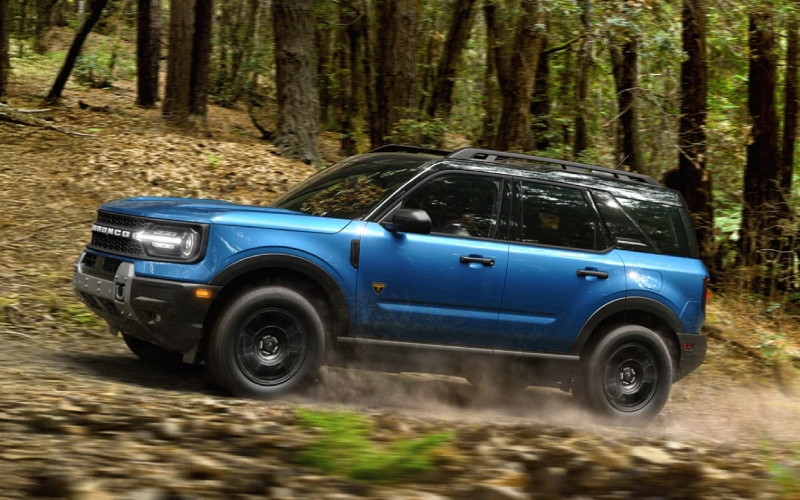
Alpine Ford – Which SUV Handles Daily Adventure Better, the 2026 Ford Bronco Sport or the 2026 Jeep Compass around Canon City, CO?
What shoppers are really asking
When drivers compare the 2026 Ford Bronco Sport and the 2026 Jeep Compass, the first question is deceptively simple: which one handles daily adventure better around Canon City, CO—meaning paved commutes, quick errand loops, and spontaneous detours onto gravel or rutted two-tracks? That mix of needs highlights differences in how each SUV puts down power, manages traction, and keeps the cabin organized for real life. Below, we break down the core systems and everyday touches that turn a “maybe” into a confident “yes” when the road surface changes or the schedule stretches late.
At a glance, both bring standard 4×4 and advanced driver-assist tech. However, Ford leans into adventure mechanics with G.O.A.T. Modes® and available twin-clutch torque vectoring on Badlands®. Jeep counters with Selec-Terrain® and a strong 2.0L turbo across the Compass line, including a Trailhawk® model built for tougher lines. Both play in the same compact footprint, but they don’t feel the same once the pavement ends or the cargo bay is full.
Off-road systems you can feel in town
On paper, selectable drive modes may look similar. In practice, how they’re calibrated is what you notice at 10 mph on a washboarded county road. The Bronco Sport’s G.O.A.T. Modes® adjust throttle, traction, and shift programming to match surfaces, giving you precise response when one side of the car is on dusty marbles and the other on packed dirt. With the available advanced 4×4 and twin-clutch rear drive unit, the system can send most of the rear-axle torque to a single wheel—so the SUV doesn’t “hunt” for grip. Jeep’s Selec-Terrain® offers Auto, Snow, Sand, and Mud for every trim and adds a Rock mode on Trailhawk®, complemented by Hill Descent Control. That’s capable hardware, but in day-to-day mixed conditions, the Ford’s torque-vectoring approach makes transitions smoother and steering inputs more predictable.
For practical life in and around Canon City, those details matter when you merge from a short on-ramp, round a dusty bend near Royal Gorge routes, or ease into a rutted parking area for an early hike. The Ford’s composure limits wheelspin and head toss, which keeps passengers comfortable and the driver relaxed.
Towing and trail-ready add-ons
Both SUVs are ready for light toys and weekend gear, but the numbers favor Bronco Sport for small trailers. Properly equipped, it tows up to 2,200 pounds, while the Compass is rated up to 2,000 pounds. That extra margin can be the difference between bringing a compact pop-up plus bikes or leaving something behind. Skid plates and underbody protection are available on both lineups, and the Ford’s catalog adds packages—like Bronze + Black Diamond® and Sasquatch® on select trims—that stack functional upgrades with purposeful styling. For drivers who want an SUV that “dresses” for the task, those options make it easier to specify what you truly need.
Another everyday win for Ford is how calmly it applies power with a load on. Climbing toward Skyline Drive or easing down to the river with a kayak rack mounted, the Bronco Sport’s mode-based tuning helps keep throttle inputs smooth, which means fewer jolts transmitted through a trailer coupler and steadier control through tight turns.
Cabin tech and cargo usability
The Bronco Sport’s 13.2-inch center display with wireless Apple CarPlay® and Android Auto™ compatibility makes quick work of navigation handoffs and playlist changes. Ford’s interface is clean, bright, and legible at a glance, and the included Ford Connectivity package for one year simplifies remote features. Jeep’s Uconnect® 5 system is fast and straightforward with a 10.1-inch touchscreen, and the available 10.25-inch Digital Cluster brings crisp driver info. Where Ford pulls ahead is in the way the cabin supports real cargo—broad openings, square corners, tie-down points, and clever cubbies that keep small items from migrating into corners.
If you spend weekends bouncing between errands, youth sports, and trailheads, easy-loading cargo bays matter more than you think. The Bronco Sport’s upright design swallows coolers, duffels, and folding chairs without a puzzle. That efficiency shows up every day, not just on big trips.
To help organize the differences, here are quick reality checks many Canon City drivers consider:
- Where does traction matter most: Mixed-surface curves, gravel transitions, and uneven parking areas—Ford’s torque-vectoring advantage shows up here.
- Which screen keeps you calmer: A larger 13.2-inch interface with wireless integration reduces taps and distractions in the Bronco Sport.
- What kind of towing margin do you want: An extra 200 pounds doesn’t sound like much until you add bikes, a cooler, and camping bins.
Ride quality is another nuance that matters at sub-highway speeds. Ford’s HOSS Off-Road Suspension helps the cabin stay settled on chatter and ripple—precisely the kinds of surfaces that fatigue drivers over time. Jeep’s setup is competent and secure, especially in Trailhawk® guise, but the tuning feels more generalized, while the Ford calibration feels like it was obsessively dialed for transitions.
Ultimately, both SUVs are good choices for Canon City, CO, drivers who want compact size and real utility. If your life regularly blends city streets with gravel connectors and last-mile dirt, the Bronco Sport’s mechanical strategy—modes, torque vectoring, and a calm ride—turns “adventure-ready” from a slogan into an everyday feeling.
Frequently Asked Questions:
Does the Bronco Sport’s larger screen really matter on short drives?
Yes. A larger, brighter 13.2-inch display with wireless Apple CarPlay® and Android Auto™ compatibility makes it easier to glance, confirm, and get back to the road. That reduces the “hunt” for icons and the mental load of navigating unfamiliar streets.
How do the 4×4 systems differ in practice?
Both are capable. Ford’s G.O.A.T. Modes® and available twin-clutch rear drive unit emphasize proactive traction and stable cornering on mixed surfaces, while Jeep’s Selec-Terrain® with Rock mode on Trailhawk® is strong for slow technical scenarios. Around town, Ford’s torque management feels especially composed when conditions vary from block to block.
Which one tows more confidently?
Both handle light towing well. The Bronco Sport’s higher available rating—up to 2,200 pounds—gives you a buffer when packing extra gear, and its traction tuning helps keep inputs smooth on grades and in crosswinds.
If you are weighing daily comfort against real-world capability, a focused test drive is the best teacher. Try the same loop—city blocks, a short highway stint, then a stretch of maintained gravel. Listen for cabin shake, note steering feel on loose surfaces, and pay attention to how calmly each SUV meters power from a rolling start. One will feel more “sorted” for your life—and many Canon City shoppers find that’s the Bronco Sport.
Alpine Ford is proud to help shoppers compare these two SUVs, serving Colorado Springs, Canon City, and Castle Rock with hands-on guidance and local-drive evaluations that mirror the way you actually use a compact 4×4.
Request more 2026 Ford Bronco Sport information
Connect with us


- July 2026
- June 2026
- May 2026
- April 2026
- March 2026
- February 2026
- January 2026
- December 2025
- November 2025
- October 2025
- September 2025
- August 2025
- July 2025
- June 2025
- May 2025
- April 2025
- March 2025
- February 2025
- January 2025
- December 2024
- November 2024
- October 2024
- September 2024
- August 2024
- July 2023
- April 2023
- February 2023
- January 2023
- October 2022
Archives
- 2025 Ford F-150
- Alpine Ford Dealer
- Alpine Ford, LLC Service
- Ford Bronco
- Ford Bronco Sport
- Ford Bronco Sport Service
- Ford Dealer
- Ford Escape
- Ford Expedition
- Ford Explorer
- Ford F-150
- Ford Maverick
- Ford Mustang
- Ford Mustang Mach-E
- Ford Ranger
- Ford Service
- Ford Super Duty F-250
- Ford Super Duty F-250 Service
- Ford Super Duty F-350
- Ford Transit
- New Inventory
- Parts
- People
- Pre-Owned Inventory
- Service
- West Pueblo Ford Dealer